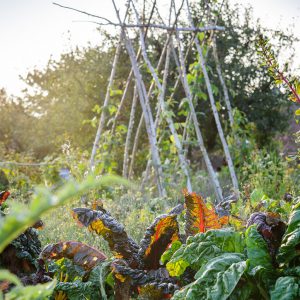
Every season has its own charm, but late summer in the vegetable garden is truly the highlight. The garden is chock-full of goodies: so much to harvest, preserve and store away for the winter… and the colours are rich, ripe and warm. The sight of this natural splendour and abundance gives every gardener an enormous sense of peace and satisfaction.
In this article we review the activities in the vegetable garden from August to the end of October.
AUGUST
 The start of August is like a second spring in the vegetable garden. There is sowing and planting to our heart's content – ensuring we have our daily portion of fresh vegetables in the coming winter months too.
The large cold frames in the fig courtyard are almost entirely replanted. Using a garden line, we sow short rows of salad leaves and herbs: rocket, leaf mustard, buck’s-horn plantain and endive (Altijd Witte), cress, coriander, dill and radish; as well as a large proportion of chervil and miner's lettuce.
We are also sowing brassicas – to prick out in a few weeks' time – the last autumn cauliflowers, Chinese cabbage and pak choi; and winter cauliflowers for a harvest in early spring.
And alongside that, rows of butterhead lettuce, iceberg lettuce, sugarloaf, broad-leaved endive (which here invariably skarol is called) and the Italian overwintering endive varieties with grandiose names like Cabello di Angel, Rosso di Verona or Variegata di Chioggia.
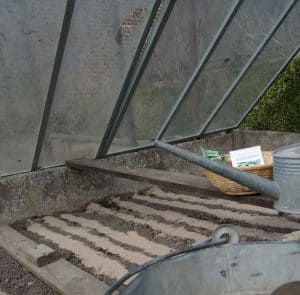 In the vegetable garden, the plots of onion, shallot and early potato are harvested to make way by mid-August for rows of lamb's lettuce (de Cambrai), small turnips, black radish and spinach (Winterreuzen) – and a final sowing of French beans. Ideally, savoy cabbage and Brussels sprouts have already been planted by the end of July.
In the second half of the month, the final winter leeks are planted. The outdoor tomatoes are topped and stripped of their leaves. The rows of strawberries that are being kept are thinned and mowed with a machine. The oldest rows are dug up – and we collect the young runners to establish a new row of strawberries.
![12036631_708204212646341_1529936586400035635_n[1]](https://www.hex.be/wp-content/uploads/2016/01/12036631_708204212646341_1529936586400035635_n1.jpg) September
September
September starts with the harvesting of pears and apples in the standard orchards. Meanwhile, in the vegetable garden white cabbage (Filderkraut) harvested for the preparation of sauerkraut, tomatoes di Napoli for the passata, basil for pesto, and autumn raspberries, figs and apricots for jam or preserving jars.
The autumn leafy vegetables – the butterhead lettuce, sugarloaf, endive and chicory – are ready in the cold frames to be transplanted. They are pricked out either in the frame or in the open ground – but need some protection in the event of night frost.
Keep in mind that by mid-October growth almost completely stalls – the number of daylight hours drops below ten hours a day – and the growth process in the plants will not resume until March of the following year. Therefore, anything you want to harvest in winter or early spring should ideally enter the month of October fully grown.
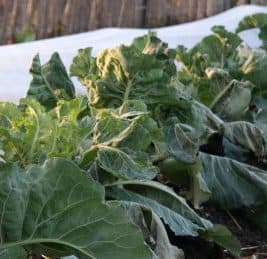 This applies in particular to overwintering cauliflower, Brussels sprouts and savoy cabbage. Winter sprouting broccoli, still unfamiliar to many, is particularly worth trying ( tenderstem broccoli ) – with a little protection, it produces an abundance of small, tasty buds on long stems as early as March.
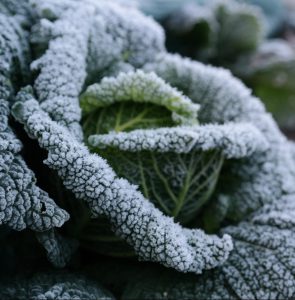
Tip for beginners: do not make a mistake when choosing the savoy cabbage. The blonde or light green varieties are for summer cultivation and freeze at the first cold snap. Choose a firm head with a bluish-green colour – which indicates winter hardiness.
By mid-September, a third of the chicory roots have already been lifted and set in soil in one of the cold frames for forcing, ready for a first harvest in December. Lifting the roots in batches is useful: staggered lifting gives a staggered harvest.
BLANCHED DANDELION
Dandelion grown for blanching, which is closest of all to the wild dandelion, can be treated in the same way. For the best harvest over the coming months, sow it directly in a cold frame in June, cut it back in September and then cover the frame with boards to exclude the light.
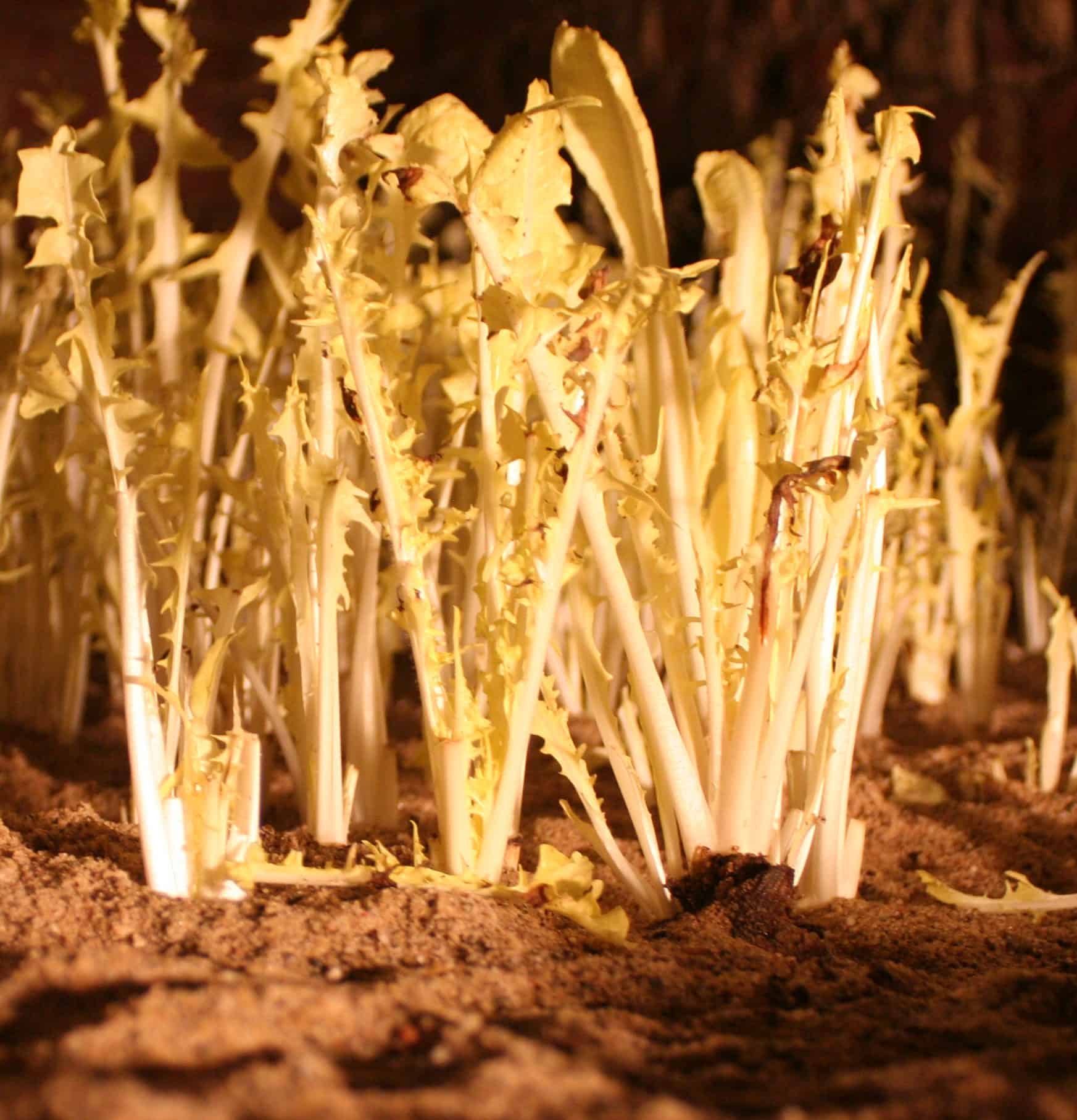 By the end of the month, the celery is tied up and earthed up, and depending on the variety, endive is also blanched under pots. Cardoon, the champion among blanched vegetables, is left to grow on for another good month in the open ground and will be discussed again in October.
chicory
The first chicory is harvested from September onwards. Using a digging fork, the roots are pulled up and laid out in long rows. Then the foliage is cut off, one to two centimetres above the root. Here it is important that the growing point remains intact. For ease of working, the chicory roots are also trimmed at the bottom until they are all roughly the same length. Affected parts are also cut away.
Setting the chicory roots in soil for forcing requires some preparation. At home, you can place the roots in a bucket or a tub of sharp sand in a dark cellar. At Hex, given the quantities involved, we set them in the cold frames of the nursery garden. First, we remove the soil from the frames to a depth of about forty centimetres. The roots are then arranged neatly side by side in a row against the edge of the pit. A shovelful of sand is placed against each row before starting the next.
Forced chicory is susceptible to slime rot. Therefore, afterwards we water the whole thing slightly with a solution of horsetail extract (Equisetum) and we sprinkle seaweed lime over the cut crowns of the chicory, after which the entire stack disappears beneath a layer of a good ten centimetres of dry, loose soil. Should your work be interrupted by a rain shower, it is advised to keep the soil that you have shovelled out of the trench (and which you are therefore going to use as cover soil) dry by covering it with a tarpaulin.
Chicory can freeze, so we put another thick layer of loose straw on top of the casing soil. The entire perimeter of the pit is also lined with plenty of straw, and corrugated sheets are placed over this entire structure to keep everything dry.
It takes an average of thirteen weeks before the first chicory can be harvested. Harvesting from a single batch can often be done for several months, but in order to harvest chicory extra early and, if possible, also until Easter next year, it is therefore advisable to work in at least two different batches.
October
With the month of October, winter is just around the corner. October is entirely dedicated to the harvest. Before the feast of All Saints (1 November), we want all our storage vegetables safely in our cellars.
First we harvest all the tomatoes – including the green ones – and let them ripen indoors in shallow crates. They do not need sun or light for this – just warmth is enough to let the final fruits turn red.
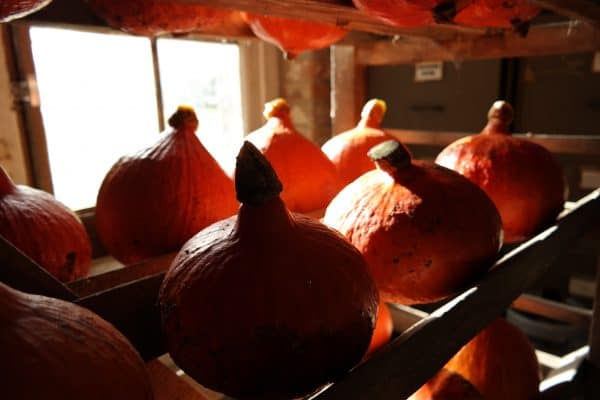
The pumpkins are not harvested until the stems of the fruit show signs of ripening: the stems colour, shrink and ‘cork’. However, do not run the risk of an unexpected autumn frost catching your pumpkins, because once the skin is frozen they can no longer be stored.
As long as the weather permits, we will steadily continue bringing in the harvest: potato, carrot, parsnip, beetroot, turnip, black radish, salsify, parsley root, tuberous chervil, celeriac and white cabbage are promptly moved to the vegetable cellar, where they are clamped in boxes of sharp sand, replanted or hung up.
The leek remains in the garden, but to be able to harvest it even during periods of prolonged frost, the soil between the rows is covered with a layer of autumn leaves.
The runner beans are already being pulled out of the ground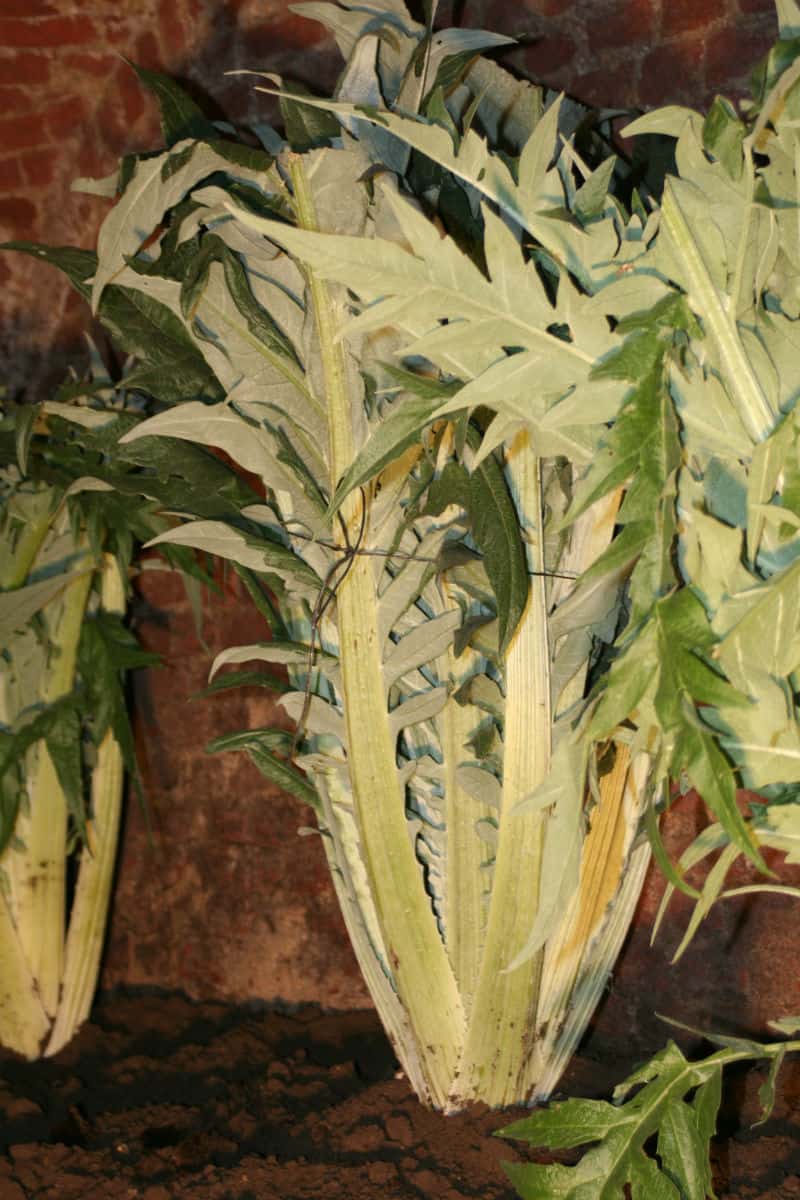 to dry more quickly. The small flageolet bean plants are tied together with string and hung to dry under the eaves of the shed, alongside the onions and shallots.
Depending on the weather, the cold frames are covered with glass in mid- or late October, then with reed mats as it gets colder. This gives us fresh greens and small, tasty harvests every day throughout the winter.
Cardoon
Finally, the large cardoon plants are prepared for transport to the cellar. With the lower leaves removed and the remaining ones tied into a sturdy bundle, the plant is dug up root ball and all, to be replanted in total darkness in the furthest cellar. The first cardoon – the blanched leaf stalks are eaten – is harvested around Christmas.
vegetable cellar
In former times, every castle and every abbey possessed a vegetable cellar. It is, as it were, the ‘fridge’ of pre-industrial times and in recent years we have seen a growing interest in the concept – and also modern applications.
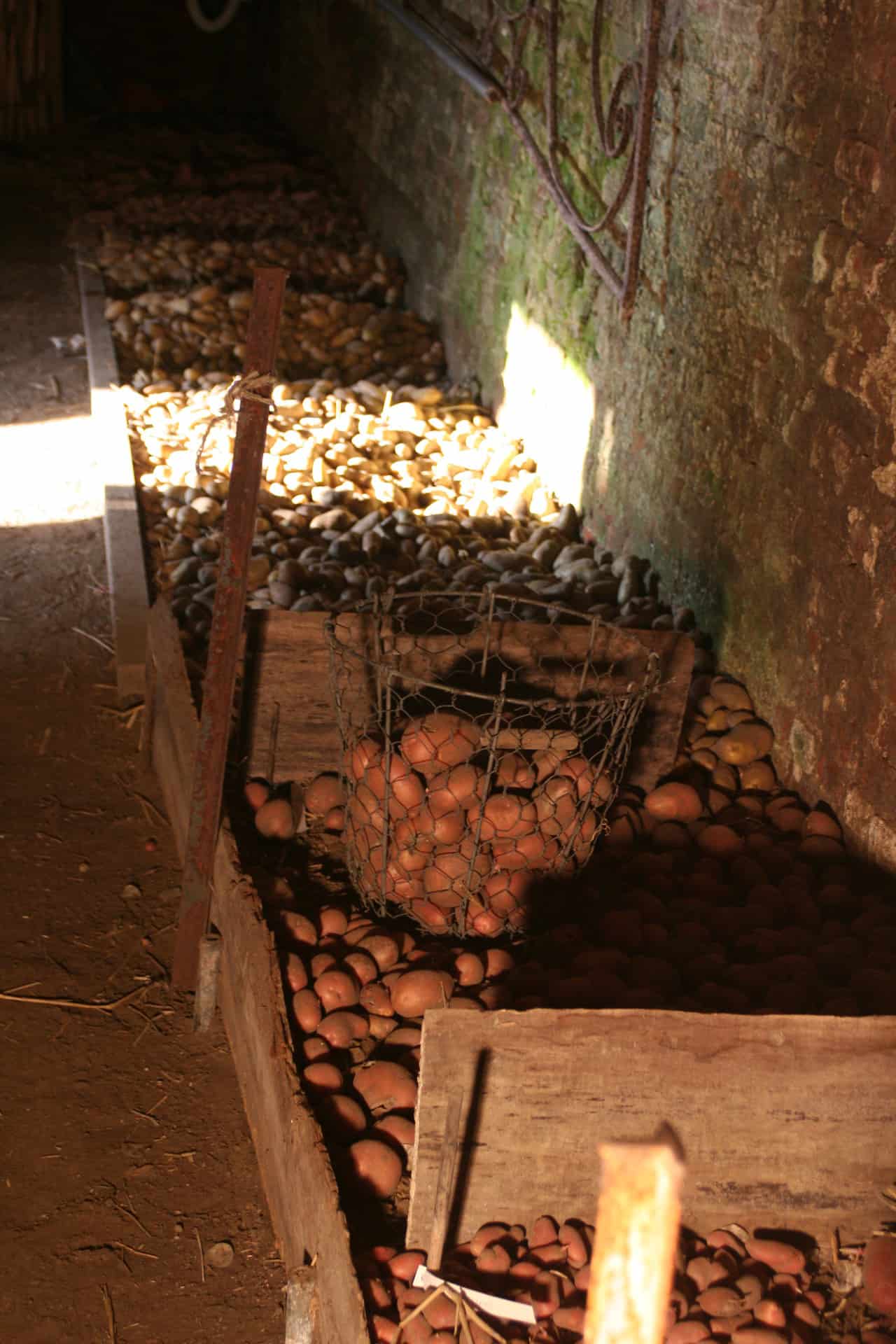
The vaulted vegetable cellar of Hex is probably the last of its kind still in use. In autumn, the harvest traditionally moves from the kitchen garden to the cellar for storage. Some vegetables are buried with their root balls while others are piled in sharp sand or hung from the vaults.
While it is winter outside, the vegetables in the root cellar remain fresh and available to the kitchen until late spring.
The ideal conditions for a root cellar are: protected from light and free from frost; a stable environment without major temperature fluctuations (from one metre underground it is between 10 and 14 degrees throughout the year) and a fairly high relative humidity – while still allowing for good ventilation every now and then.
A vegetable storage cellar prefers not to have a concrete floor, but an earthen one – just like a good wine cellar.
 November
In the month of November, we begin getting the vegetable garden ready for winter. As the plots become available, they are covered with the layer of autumn leaves collected from the paths and lawns. Covering the bare earth protects the soil life against the cold and prevents the soil from being beaten down by the rain. It provides the worms with sufficient food and ensures that in spring, when you clear the beds again, you can get back to work without having to weed.
Support canes, poles and bean sticks are collected and stored away; and as we thus dismantle the vegetable garden, we make a note on a plan once again of which crops were in each plot.
December
After this, the vegetable garden will largely go into hibernation until March of next year. We will only enter the remaining winter plots, where we will still harvest corn salad, spinach, leeks and the remaining endive on a weekly basis.
We only start harvesting savoy cabbage and Brussels sprouts once it has frozen properly for the first time. After all, as soon as the temperature drops below freezing, the starch present in the cabbages is converted into sugars – which makes them remarkably tastier. We take root and tuber vegetables from the storage cellar, and fresh salad leaves, blanched dandelion leaves and chicory can be found in the cold frames all winter long.
Text and photographs: Gust Duchamps
except for photo pears and photo chard: Jason Ingram
https://www.jasoningram.co.uk/gardens/kasteel-hex-kitchen-garden/