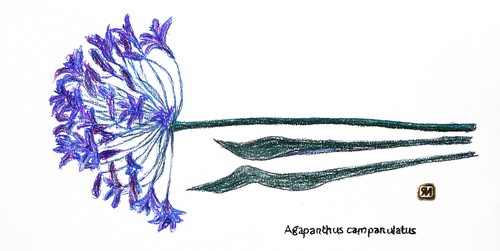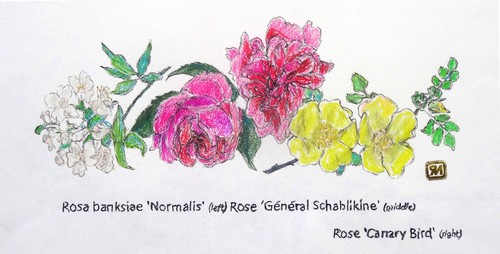
‘Man does not live by bread alone.’ Alongside vegetables, herbs and fruit, the kitchen garden of Hex Castle also provides a rich selection of cut flowers for the table and buffet.
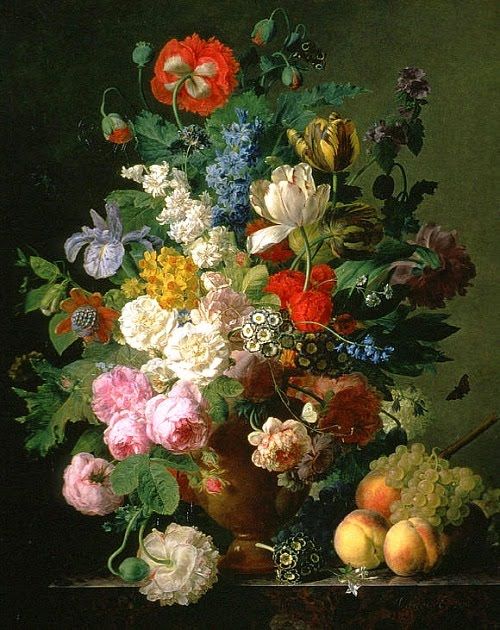 Paintings by the old masters show us the Baroque compositions that were popular in the eighteenth century. It was country estates like Hex that provided the nobility or urban bourgeoisie with a supply of fresh fruit, vegetables and flowers. A rich bouquet, often containing unusual or rare plants, not only provided enjoyment for the house, but also symbolised the status, cultural education and cosmopolitanism of its residents.
Throughout the centuries the style of the bouquets evolved and the range of cut flowers became more extensive, but although new discoveries and variations still appear on the garden markets every year, there is a certain canon of beautiful and reliable cut flowers that has hardly changed.
The tulips Carnaval de Nice or Flaming Springreen, with their red flames, just like Black Parrot with its serrated leaf edges, look as though they have stepped straight out of an eighteenth-century Baroque painting – and they are still in our range – but in early spring we choose the more simple elegance of the white tulips Angel’s Wish, Springreen – with a touch of green – and the lily-flowered White Triumphator – all with long 40 cm stems. Fragrant hyacinths are raised in pots in the greenhouse and create pleasant accents in the home.
In May, the peony-flowered tulips bloom on the large parterres in front of the château. The soft pink, double-flowered Angélique is without doubt the favourite among the tulips – and because it has a relatively short stem, it is ideally suited for a hand-tied bouquet or a table arrangement.
To stay on the subject of flower bulbs for a moment: the deliciously fragrant poet’s daffodils Narcissus poeticus recurvus and Narcissus x odorus plenus flower – in contrast to the yellow daffodils – until late May. Along with the last tulips, these narcissi combine well in a small floral arrangement with, for example, the oxeye daisy (Leucanthemum vulgare), lady's mantle (Alchemilla mollis) and flowering chives (Allium schoenoprasum).
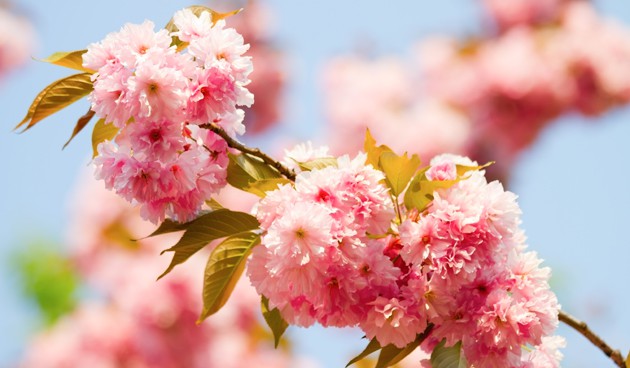 Flowering shrubs and trees also make an important contribution to the bouquets. Flowering branches can be found both in the woods and at the woodland edge, in the borders of the formal gardens and in the meadows. Early in the year, it is forsythia (Forsythia) and Japanese kerria (Kerria japonica) which herald the spring with their cheerful yellow. Forsythia has been cut from February onwards and forced into bloom in the greenhouse – we do the same with pussy willows (Salix alba Vitellina).
When fruit-tree blossom turns Haspengouw white, we bring indoors large flowering branches of ornamental cherries (Prunus serrulata Amanogawa and Kanzan), hawthorn (Crataegus) and later decorative apple varieties (Malus) in white, pink and red varieties.
From mid-May onwards, they in turn make way for the long branches with white pompons of the guelder rose (Viburnum opulus), or the fragrant white flowers of lilac (White lilac). With both, it is recommended to remove the young green shoots and also most of the foliage from the branches immediately after cutting. I only leave the top pair of leaves beneath the flower – much like I do with most roses or dahlias for bouquets, by the way. Before putting them in water, the bottom of the stem is split lengthways once or twice from the cut end with pruning shears – this will allow the branch to absorb more water.
What we call green branches include, for example, those of variegated privet (Ligustrum tricolor) or St John's wort (Hypericum androsaeum). These species have a slightly tougher and firmer leaf that holds up well when the stems are used in floral arrangements. Provided, however, that you do not cut young stems, but stems with a matured woody base; and that you split them at the bottom or bruise them in some other way. Privet has a very pleasant sweet scent when in bloom in the month of May – and decorative clusters of berries in autumn, but its stems are a good base material almost year-round to combine with tulips, irises, peonies, roses or dahlias.
St John's wort blooms with butter-yellow flowers and striking stamens. The berries change colour from green to yellow and ochre-red, while new flowers continue to appear above them. St John's wort remains attractive until late autumn and forms a loose bouquet on its own or, as above, the basis of a composite floral arrangement.
All woody branches are cut at least 24 hours in advance and placed in large tubs of fresh water to drink in a cool, shaded place before they are made into flower arrangements.
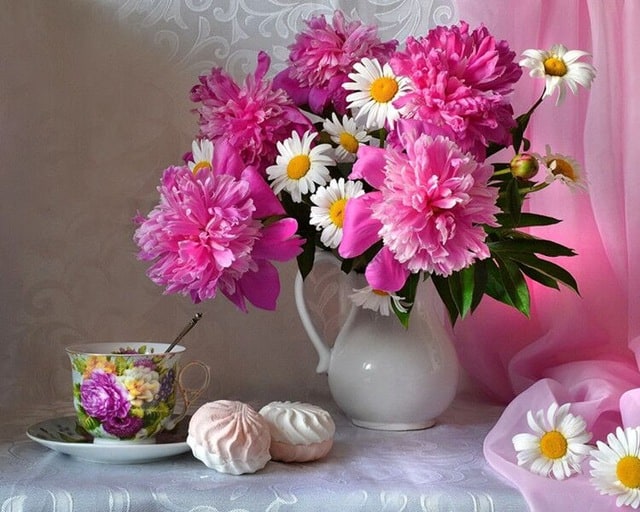 At the beginning of June, the Chinese peonies (Paeonia lactiflora hybrids) put on a magnificent display. In the vegetable garden they are scattered among each other in two long rows: large white, pink to crimson, single, two-coloured, or pompon-filled flowers on sturdy, straight stems. With a length easily reaching 40 centimetres, they quickly make a successful romantic bouquet for the large vases – and that without requiring much else to go with them. But the peonies also look their best in a smaller, mixed floral arrangement – for this we choose the white and soft pink flowers in their closed bud stage.
That the garden days of Hex Castle are pre-eminently a celebration of the roses is well known among garden enthusiasts. The rose is therefore by no means coincidentally the queen of cut flowers. From early spring we occasionally cut long flowering branches from the botanical roses such as Rosa primula or Rosa banksiae alba plena – or from the early-flowering Kordes rose Frühlings Gold. And we already use the first flowers of the fragrant Japanese rose (Rosa rugosa hybrids) in the earliest table arrangements.
The hybrids of the China tea rose with their many shades of colour, their characteristic citrus scent and their availability all year round are much sought after as cut flowers. They have long, straight stems and last exceptionally well in a vase; and the fact that they continue to bloom until the frost means they have secured a permanent place in our range.
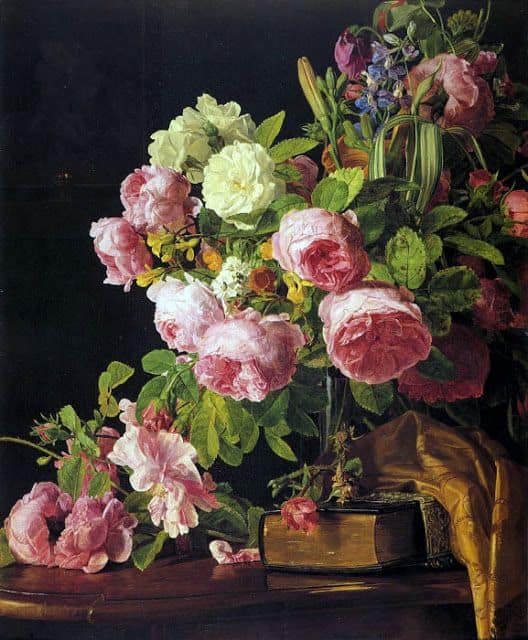 The family of English roses was developed in the last century by David Austin. These roses combine the best characteristics of hybrid tea roses with the luxurious appearance and varied aromas of old shrub roses: they are repeat-flowering while at the same time breathtakingly beautiful.
During the months of May and June, the roses of our favourite historic rose bushes open: Gallica roses, albas, Bourbon roses, centifolia and Damask moss roses in many crosses and varieties: a feast for the eyes and the sense of smell – both in the house and in the garden. The Gallicas and Damask moss roses are romantically casual and slouchy, whereas the albas are rather more refined and the centifolia moss roses are heavier, more baroque and more heavily perfumed – often cup-shaped, double, half-closed like a cabbage. It is these cabbage roses that we find back in the paintings of the old Flemish and Dutch masters.
Building a classical style floral bouquet, as a buffet or freestanding piece in a hall or reception room, usually begins with a backdrop of green branches and leaves on a structure of metal and oasis. Branches and flowers have soaked in water overnight and are cut to length – hollow stems are reinforced with a small stick.
Delphinium (Delphinium hybrids), lupine and foxglove (Foxgloves) provide height and verticality. Arching branches with small roses bring movement to the picture. Besides the roses, tulips, peonies and lilies are striking focal points of a classical bouquet. Adding sweet William (Dianthus barbatus) and zinnia (Zinnia elegans) conjures up the luxurious atmosphere of the eighteenth-century bouquet.
 From the very beginning of their existence, the art of gardening and floral decoration at Hex have been influenced by a major undertow in English artistic life: the desire for naturalness. The natural style tied in well with the Arcadian dream of the castle’s first inhabitants. It is therefore no surprise that the choice of plants at Hex also shows traces of the Arts and Craftsmovement, which flourished in Great Britain in the early twentieth century, and the cottage style that grew out of it. The typical cottage garden contains fruit, shrubs, vegetables and flowers in a spontaneous mix, and the surrounding garden and nature are reflected in the bouquets indoors. Floral arrangements in the Arts and Craftsstyle do not seek the elaborate profusion of colour and form of an eighteenth-century bouquet, but excel in purity, gentle variations and simple expression.
For a formal dinner, old and English roses are combined with robust yet elegant perennials from the mixed borders: oxeye daisy (Leucanthemum), yarrow (Achillea), red valerian (Centranthus ruber), scabious (Scabiosa), ornamental allium (Allium), iris and aster; but also the aforementioned peony, foxglove and delphinium – all in their most natural appearance.
The flowers are preferably picked the evening before or early in the morning and then left to stand for at least eight hours in large buckets of cool and clean water before they are processed.
Alongside the roses, table decorations almost invariably feature the ubiquitous lady’s mantle (Alchemilla mollis) with its fluffy clouds of warm yellow and the lavender-blue catmint (Nepeta faassenii) – often still accompanied by the soft green-variegated foliage plant pelargonium Charity and the straight, deep blue ears of Salvia farinacea Victoria. These latter are carefully cultivated in the heated greenhouse and spend the summer on the parterres next to the south façade of the castle.
A very natural effect comes from the lime-green chamomile (Matricaria), once again a leftover of the floral art of the Arts and Crafts- movement, which with its scattered simple white little flowers with a cheerful yellow heart ensures cohesion in a bouquet. The plant is annual but has for generations spread spontaneously throughout the garden.
 Little gems like columbine (Aquilegia), each specimen seemingly unique, or greater masterwort (Astrantia major) or the annual spurge (Euphorbia marginata) give the arrangement the necessary luxury and refinement.
When the summer months arrive, the style of our bouquets becomes freer. For a loose bouquet in the vase, we cut a bunch of tall annuals from the vegetable garden: a mixture of white and pink Cosmea (Cosmos bipinnatus ) – of which we think the white psyche is the loveliest – combined with the delicate lace work of the umbellifer Ammi majus or the flower heads of Florence fennel.
A good newcomer for the tall vase is the flowering shrub Vitex angus – which allows bouquets with a voluminous yet light appearance to be quickly cut using its branching white flower spikes.
Small mixed summer bouquets from the vegetable garden are put together while picking: roses or the first dahlias with zinnias, the purplish-red amaranths, Verbena bonariensis, a bit of sage or chamomile are quickly gathered together. The bouquet is like a real Biedermeier spherical, fitting nicely in the hand, wrapped in a few hosta leaves and tied with raffia.
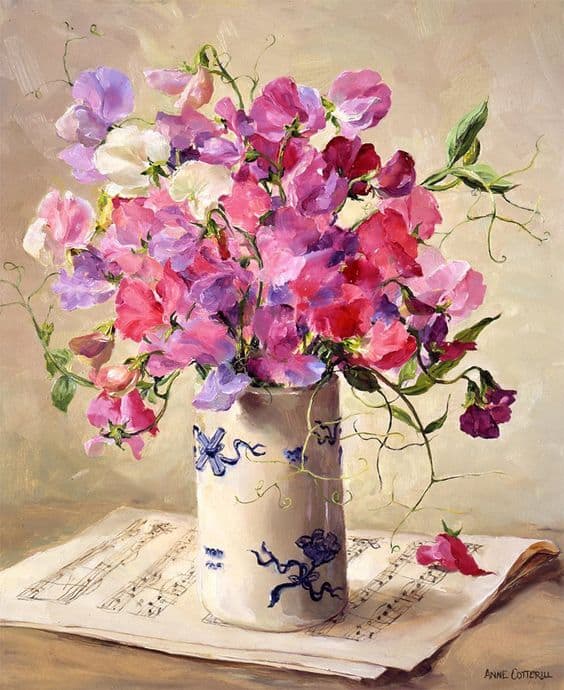
A fragrant bunch of sweet peas (Lathyrus) by the dressing-table mirror is one of the house’s charming little traditions. Every year, we sow a mixture of our own saved seeds in white, pink and violet.
While the coming late summer changes the colours of nature, the rustic style continues in the large, loose bouquets of sunflowers (Helianthus annuus mix). We sow sunflowers directly in the vegetable garden – a mix of relatively small and branching varieties – preferably only after 1 June, for the reason of being able to cut them for a long time into the autumn. A bouquet of sunflowers in a vase accompanied by cosmos sulphureus and Tagetes Linnaeus – from fiery yellow to all shades of warm orange – best captures the atmosphere of the kitchen garden in the harvest months.
From early September, increasing numbers of dahlia's from the kitchen garden gradually transform the bouquets. In formal arrangements for the September festivities, colourful dahlias take the role played by roses in June.
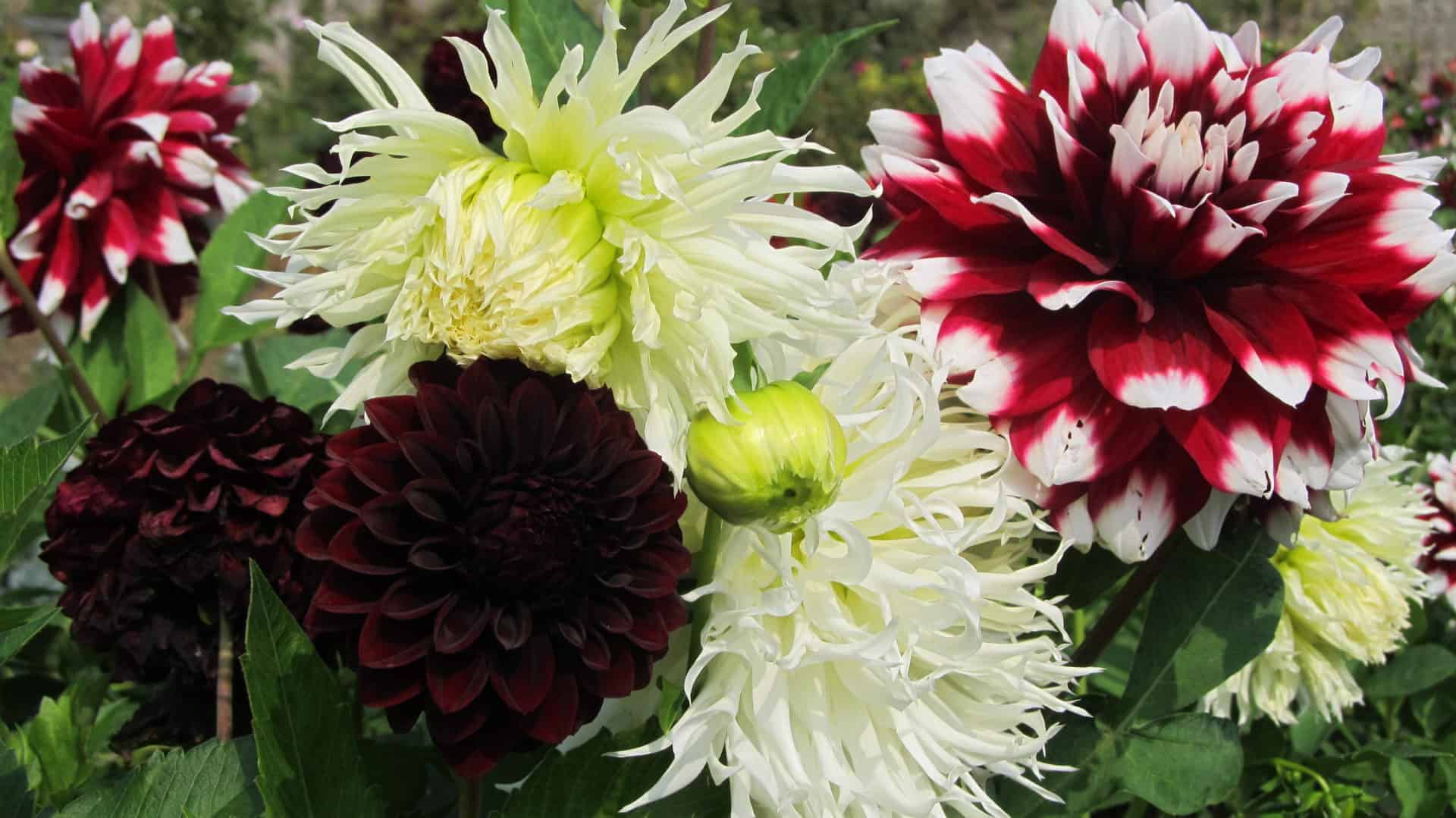 Dahlias come in a huge variety of shapes and different multi-coloured hues. There are pom-poms, which we rarely use, and single-flowered ones on slender stems with a very natural look. The most commonly used cut flowers are the more baroque varieties with ruffled (decorative) or pointed petals (cactus): Bordeaux-red Chat Noir, peach-coloured Eveline, orange Gwyneth or white Polar Ice.
They are ideally suited for small bouquets, but it is possible, albeit with a little sacrifice, to cut long-stemmed flowers of up to 50 cm.
Dahlias are the eye-catchers in formal arrangements, combined with zinnia, amaranth, Salvia 'Victoria', Verbena bonariensis, the now tall pelargonium 'Charity', the blades of grass of Pennisetum setaceum Fireworks or the arrow-shaped inflorescence of Persicaria orientale ‘Kiss-me-over-the-garden-fence’.
Gradually, we also see the first bouquets of asters, white or sky blue, and also stonecrop 'Herbstfreude' finds its way into the arrangement. We continue to cut annuals and dahlias until the first night frost sets in. We also return to the St John's wort and privet branches, which now bear berries, and finally end the season where we began: the branches with ornamental apples whose blossom we admired in the spring, and the gracefully drooping branches of large shrub roses, laden with rosehips and a single final rose.
Text: Gust Duchamps, head gardener.
This article previously appeared in Fence Tuinmagazine.