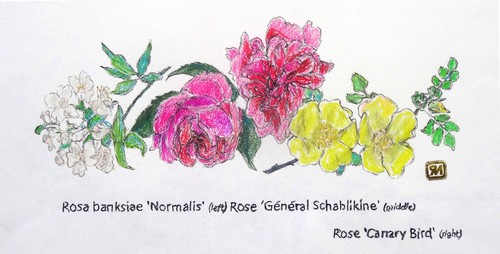
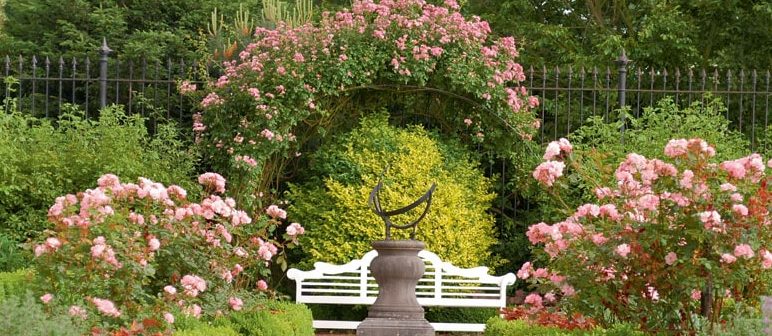
The history of Hex has always been a story of roses: from the oldest rose varieties, which Prince-Bishop de Velbrück had imported from China by the United East India Company in the 18th century, to the collection of old and rare roses gathered by Countess Nanda d’Ursel, down to the latest creations of the world's most renowned rose breeders today. Over the past half-century, the rose collection at Hex Castle has been continually expanded. There are an estimated 1,400 roses scattered throughout the gardens, comprising around 500 different varieties. The roses are present in formal beds and in mixed borders, as large solitary plants, or they grow over fences, cascade over balustrades and climb among the walls and trees…..
A WORK OF GENERATIONS
The mapping of the historical roses of Hex Castle was carried out with passionate attention and dedication by the late Countess Nanda d'Ursel. She made sketches and extensively described the most exceptional roses in her garden notebook. Later, the countess met Edith Dasnoy, with whom she created watercolours of the finest varieties. Together, they published the book “Rozen uit de Tuinen van Hex” (1995). The book is still available for purchase (during the garden days at the Hex stand).
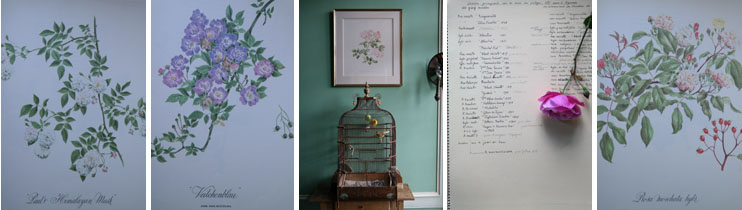
A HISTORY OF ROSES
Wild roses occur throughout the entire northern hemisphere, from the Arctic to North Africa, from the American plains and New Mexico to Yemen, Thailand, southern India and China. In the regions of Western Europe, species of the dog rose and sweet brier are native - around thirty species - but worldwide more than 200 wild rose species are known. In the wildflower meadow you will find the wild rose species that are characteristic of the flora of the Limburg and Brabant region.
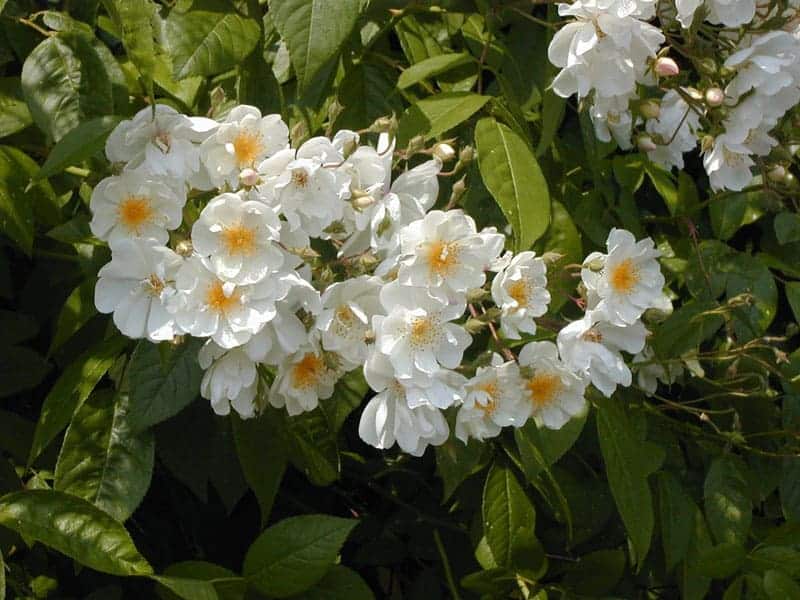
Furthermore, scattered throughout the gardens of Hex are numerous wild exotics. Several varieties of the Chinese Rosa banksiae are located near the fig courtyard, and the varieties of the Scottish Rosa pimpinellifolia stand in a row behind the tennis court. Nearby also stands the Rosa sericea pteracantha, with its striking winged thorns, which originates from Nepal. By the door of the vegetable cellar stands Rosa mutabilis. Further along is Rosa roxburgii – both also imported from China. Here and there you can see climbers of botanical origin scrambling along the garden fences, against the walls, or in the trees: Rosa arvensis, Rosa multiflora, Rosa filipes ‘Kiftsgate’, and the impressive Paul’s Himalayan Musk at the front of the castle.
The botanical species with their wild clusters and exuberant flowering are almost impossible to equal in charm and beauty. But thanks to centuries of rose cultivation, the exchange of roses between regions and continents, and the numerous crossings that this entailed, we now know an almost countless number of roses in all possible variations.
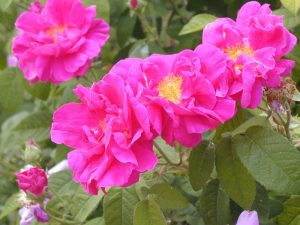 It is hard to say when the French rose (Rosa gallica) was first introduced to our region. It is native to France and further east in Southern Europe as far as Turkey. In its long history of cultivation, numerous variations of the French rose have emerged. They are all pink, fire-red to deep violet, and they flower only once a year,
but they are much loved for their special perfume. In the gardens of Hex we can see, alongside the original wild form, several dozen of the finest Gallicas collected, including Tricolor de Flandres, De la Maître d’Ecole, Alain Blanchard, Charles de Mills and many others.
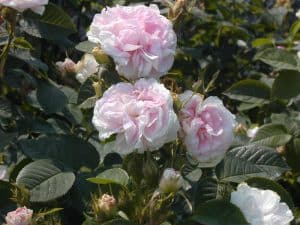 The white or soft pink Alba rose was probably already cultivated by the Greeks and Ancient Romans. It is a cross between one of the dog roses and a Gallica or possibly a Damask rose. The growth habit of the Albas is different from that of the Gallicas. They produce long, pliable branches, which incidentally have few thorns. The leaves have a bluish sheen and the flowers smell sweet. The finest specimens, represented in Hex, are Celestial, Königin von Dänemark or Great Maiden’s Blush (once also called ‘Cuisse de Nymphe’). They flower only once a year. Together with the Gallicas, the Albas are largely grouped down in the vegetable garden, in the long border that stretches alongside the sheep pasture, from the greenhouse to the old water well.
A third old family of roses is the group of the Damask roses. They are crosses of Rosa gallica with other wild species from the Mediterranean region, such as Rosa phoenicea or Rosa moschata. The Autumn Damask rose is special because it is the first to have a second flush of flowers in the late summer. The Damask roses are significantly less hardy than the Gallicas. They grow tall and bear loose clusters of fragrant, large flowers in red, white or pink.
The Centifolia rose of Provence was only born in the 16th century from a cross between an Autumn Damask and a Rosa Alba. The group was sterile for a long time and was propagated by cuttings, until in the 19th century a fertile species emerged that could be used for further breeding. Alongside the original Centifolia, in the garden at Hex we also find Petite de Hollande and Pompon de Bourgogne. The rosebushes of the Centifolia family are characterised by their thick, double blooms that are slightly closed - which is why in England they are also called the Cabbage Rose. Other names for this rose are the Dutch rose or Rose de Peintre, on account of its popularity with the Dutch masters of the 17th century.
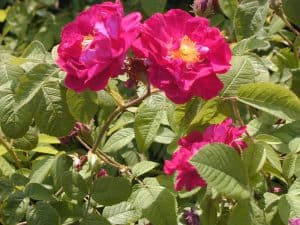 The Centifolia-Moss roses originated as a spontaneous mutation of normal Centifolia roses. The first is mentioned in 1720. The Centifolia moss rose is characterised by the presence of numerous scented glandular hairs on the flower stems. The growth habit is somewhat leggy, but that is made up for by the special character of the flower. The roses are very aromatic and the colours are deep violet or dramatically dark. Behind the double row of peonies in the kitchen garden are William Lob, Nuits de Young, Tuscany Superb and about a dozen other exponents of this family.
Roses have been cultivated in China for centuries and crossed into new cultivars. The first Chinese roses arrived in our region in the year 1792. The Rosa chinensis multipetala which still stands at the Prinsenhof garden is one of the first that were transported by the Dutch East India Company from China – according to tradition – at the special request of Prince-Bishop de Velbrück. In addition, you can still find Rosa indica rubra and an ‘Old Blush’ from that time at the Prinsenhof garden.
On the island of Bourbon, an important stopping place for merchant ships – halfway along the route between Europe and the Far East, members of the autumn damask rose family met the Chinese rose (Rosa chinensis) in the 17th century. The resulting crosses gave rise to the Bourbon rose, which was later improved by crossing with Gallica and Damask hybrids. The Bourbon rose family exhibits good re-flowering in the late summer. The flowers are often semi-double and light pink. In the garden of Hex, you will find them gathered mainly near the tennis court: Mme. Isaac Pereire, Louise Odier, La reine Victoria and others.
The Tea Rose (Rosa odorata) is a Chinese rose that has long been cultivated in China. It is called the Tea Rose because the flower has a slight scent of tea. Crosses of the Tea Rose with Noisette and Bourbon roses produced a completely new family of ever-blooming Hybrid tea roses, which are nowadays mainly known as cut roses. In Hex, they are mainly planted in the flowerbeds by the greenhouse.
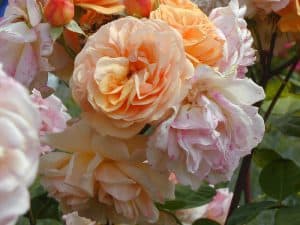 By the greenhouse, you can also find roses bred by the English rose grower David Austin. He has managed to unite the best of both families.
The romantic appearance and fragrance of the old Gallicas, Albas, Centifolias and Bourbon roses combined with the repeat-flowering character of modern Hybrid Teas.
Louis Lens, Belgian tree nurseryman and rose breeder, was a good friend of the late Countess Nanda d’Ursel. Lens took a completely new direction by breeding roses for grassland and public parks. His Moschata hybrids have been sold all over the world. At Hex, you can still find specimens from his trials, some of which never reached the market, for instance in the row next to the grottoes. But you can also find some of his finest creations in the vegetable garden and in the so-called friends' garden next to the terraces.
Countess Nanda d'Ursel also had a soft spot for the small cluster roses of the Polyantha family. We find them back in the vegetable garden; in long rows in front of the peonies and in the beds around the pond. The Polyanthas (or miniature roses) are descendants of complex crosses of Chinese roses with Centifolias, Bourbon roses or old Tea hybrids.
Finally, there is the Geschwind rose garden, which was planted in 2012 by the old cedar tree, at the back of the plane tree avenue. In addition to the well-known ‘Zigeunerknabe’, the collection contains several dozen unknown and forgotten rose varieties from Rudolf Geschwind dating from the early 20th century, gathered from old gardens and rose gardens in Western and Eastern Europe. Geschwind's roses are characterised by their natural character and their resistance to all weather conditions. This rose collection is intended as a gene bank for future breeders.

View here: the alphabetical register of the roses of Hex.
NEW ROSE NAMES THAT REFER TO HEX
Hex is particularly proud that in June 2013, to mark the 20th anniversary of the Garden Days, a number of loyal exhibitors/growers named new rose selections and cultivars after Hex. They are:
– Rosa ‘Gardens of Hex’ – Lens Roses
– Rosa ‘Kasteel Hex’ – Peter Beales Roses
– Rosa ‘Rebel of Hex’ – De Bierkreek
– Rosa ‘Spirit of Hex’ – Vierländer Rosenhof
In 2016, a new rose was named after Countess Stéphanie d’Ursel, hostess and patroness of the historic gardens of Hex Castle:
– Rosa ‘Gravin Stéphanie d’Ursel’ – Lens Roses
RECOMMENDED WEBSITES
Peter Beales – Lens Roses – De Bierkreek – Vierländer Rosenhof