
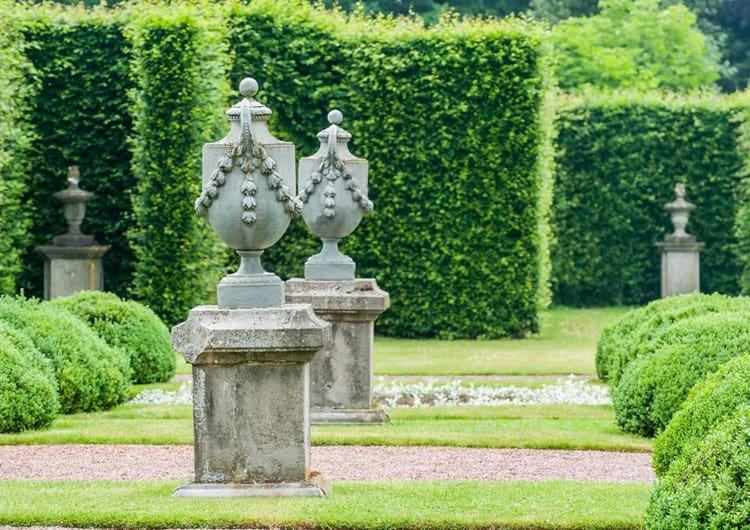
 THE FRENCH GARDEN
The gardens enclosed by high hedges at the main entrance were renovated by landscape architect Jules Janlet in the years between 1913 and 1917. Of the numerous colourful flower beds, four survived and are still planted annually with tulips and Salvias. The remaining space is taken up by long strips of lawn with scattered boxwood spheres and ornamental vases, offering a magnificent perspective of the castle's facade.
 THE TERRACES
From the southeastern façade of the castle, three tiered terraces have been laid out descending step by step, forming as it were the plinth upon which the castle is built. They were redesigned in 1990 by the Antwerp landscape architect Jacques Wirtz. The terraces are edged with Belgian blue stone and adorned with vases. A clean design of lawns and areas of dolomite gravel, bordered with clipped yew shapes, replaces the nineteenth-century flower beds with annuals. A small circular pond and pots of oleanders soften the rigorous lines. Along both sides of the terraces, rose bushes have been planted like large bouquets of flowers, and in the background one can see the old boxwoods, hollies, and yew trees that are pruned into large cloud shapes.
THE LITTLE ROSE GARDEN
Behind the high hedges of the cour d'honneur, to the left of the castle, lies a garden room now known as the small rose garden. This only acquired its current purpose in the 20th century, after the children of Countess Nanda d’Ursel had outgrown the sandbox and she herself began to focus on collecting historical garden roses. At the centre stands a small statue of Cupid on a plinth, and against the wall is a semi-circular water basin with a fountain.
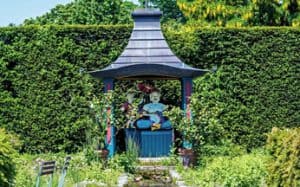 THE CHINESE GARDEN
In the Chinese garden, also known as Suzanne’s garden, you can admire an unusual chinoiserie : a voluminous laughing Buddha in polychrome woodcarving from the late 18th century. The statue is of Liège manufacture, modelled on a small porcelain piece that was in the castle. The statue is moveable: under the pressure of the wind, the head and hands move; the statue also mockingly sticks out its tongue. The garden is divided in two by a central narrow water channel. The flagstones are a typical nineteenth-century addition. Following the renovation by Countess Stéphanie d’Ursel in 2006, special plants of oriental origin are collected here.
THE PRINSENHOF
This garden on the sunny side of the castle's south-west wing owes its name to Prince-Bishop Velbrück, who overlooked this garden from his apartment. The garden has a typically French layout of 16 equal flowerbeds, based on a design by Jules Janlet. The beds are planted annually with aromatic summer-flowering plants. Two classics that always return are the ‘Charity’ scented pelargonium and the ‘Victoria’ blue sage.
In the Prinsenhof, we also find a number of remarkable roses that form the basis of the renowned rose collection at Hex. These are rose bushes growing on their own roots that have been here since the late 18th century. The Rosa indica rubra, the Rosa ‘Old Blush Hex’ and the Rosa chinensis multipetala were brought back from China at that time by the Dutch East India Company.
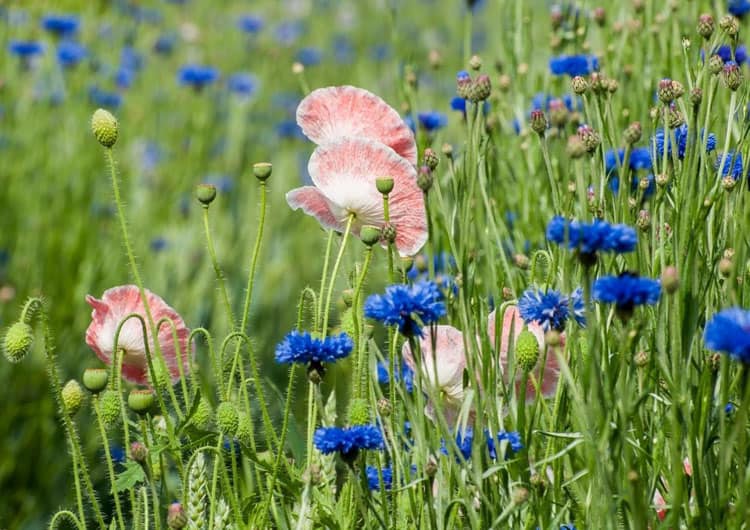 THE FLOWER MEADOW
An extension of the Prinsenhof and the Chinese Garden is the former donkey meadow. Today it is maintained as a flower meadow, with closely mowed footpaths criss-crossing the plot. This meadow is mown for hay once a year. A young plantation of lime trees from all continents promises a fine lime wood for future generations. From the footpath alongside the meadow, there is a wonderful view of the lower-lying vegetable garden, the village and the surrounding landscape.
The Bee Garden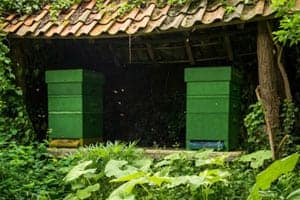 Upon leaving the vegetable garden via the small gate right at the back, one is in for a surprise: a small, romantic valley, enclosed by the brick garden walls. The beehives are sheltered beneath the tiled roof. Two coats of arms of the prince-bishop adorn a rustic watchtower. Tradition has it that the grave of Velbrück's favourite mare lies beneath this monument. The mare's name was Venus.
