
 WALK THROUGH THE PARK
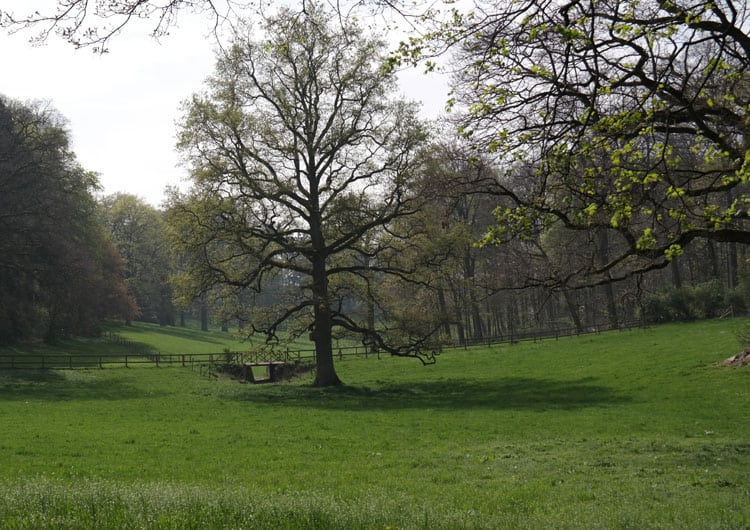
Outside the walled gardens of Hex Castle lies a large 19th-century landscape park, which has taken the place of the former English gardens. The walk usually begins at the western entrance gate to the formal garden. From there, a path turns right towards the pond. Along the way, you catch your first glimpse of the green valley dotted with solitary trees. Further on, you can choose to take a steep climb beneath the arbour to the panoramic viewpoint by the wedding column, or return via the little bridge and the hidden grottoes to the plane tree avenue.
Background
Around 1770, a number of English gardens were laid out in this place, between the French gardens and the Zavelberg, by Velbrück, which at the time were among the first of their kind on the European mainland. In contrast to the French-style gardens, these English gardens were characterised by winding paths and curved lines. Solitary trees and flowering bushes were seemingly distributed at random across the gardens. Along the route through the gardens, one came across various follies , also known as garden ornaments: small buildings in various styles intended to evoke a particular atmosphere.
The landscape designer Louis Fuchs redesigned the castle park in the years around 1880, transforming it in the spirit of his time into a large landscaped park, much as it can be seen today unchanged. Some of the existing elements still date back to the 18th century. Fuchs' greatest achievement is the elongated green valley that ends at the pond. To achieve this, the existing landscape was excavated and raised to produce the result that can still be admired today.
THE SIGHTLINES
Next to the pond, an embankment was raised in 1890 for the construction of a driveway from Lod. Lavkistraat. This hidden entrance between the yew trees is in fact the official access to the castle. The straight avenue of copper beeches is the ideal setting for driving into the French garden.
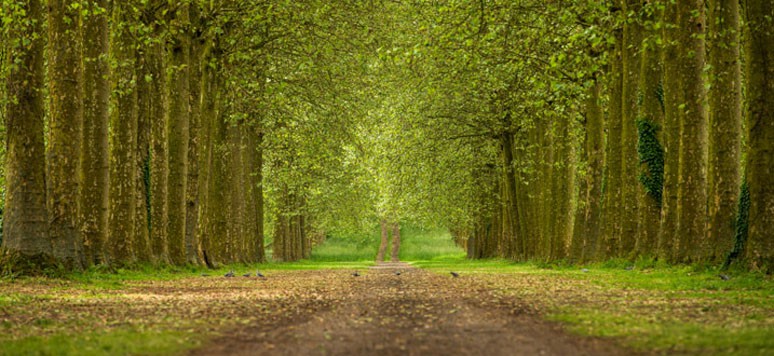
The avenue of plane trees on the eastern side of the estate is almost two kilometres long and reaches all the way to Bommershoven. In the shade of the plane trees, exhibitors and growers pitch their tents twice a year for a convivial plant festival.
