It must have been 2004 when Norbert Mergen dedicated himself to the Society for Forgotten Vegetables – completely at odds with the impoverishment of supermarket ranges. When that society went defunct, De Tuinen van MergenMetz (MergenMetz Gardens) were born (the name being a combination of Norbert's name and that of his partner, Marijke Metz). There was already a vegetable garden and Norbert also began writing about vegetable gardening, unusual crops and how to prepare delicious food with them. Naturally, everything completely organically. Biodiversity became the guiding principle and more green themes began to play a role. In 2012, the vegetable garden was joined by a small food forest, which is called the Edible Ornamental Garden. In its heart, there was also a set of four beds with medicinal herbs, plus (later) an area with dye plants.
The MergenMetz Gardens are regularly open to visitors during the garden season (please check the events calendar on the website for details). A small-scale, rotating selection of primarily unusual edible plants is cultivated, suitable for both the vegetable patch and the edible ornamental garden. Seeds are also harvested and sold. Occasionally, we collaborate with other quality growers. Finally, there is always a selection of very good books on the theme of ecological and edible gardening.
Grower's Choice June 2024
Planting MergenMetz gardens
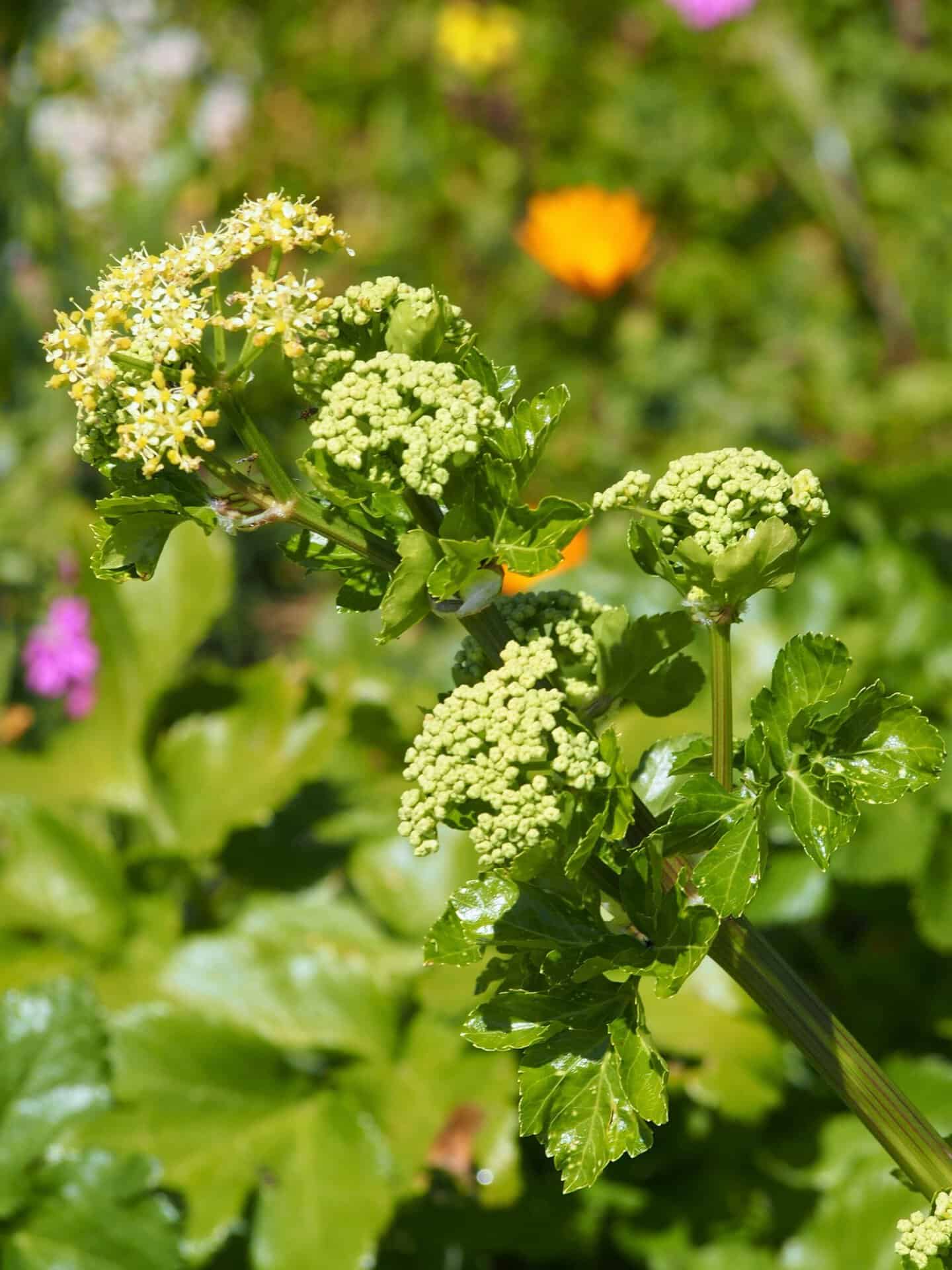
Smyrnium Alexanders, black-flowered yarrow, in the spotlight at the spring edition of Hex.
Alexers is a biennial or triennial plant that grows to about a metre high. This robust and easily recognisable plant has compound glossy leaves and produces several medium-sized yellow-green umbels early in the spring of its second year. Very beneficial for insects.
Alexanders is likely an archaeophyte in the Low Countries: a plant that was brought along by humans in the past from more southern regions in Europe, but is now found (rarely) in the wild. Sites with somewhat richer, damp soil in partial shade particularly appeal to it, potentially in a large pot.
Every part of black chervil is edible, but its use has fallen somewhat out of favour. Don’t expect the more familiar flavour of chervil, but rather something reminiscent of celery, parsley or parsnip: earthy with a slight bitterness. It is one of those early spring vegetables that start to appear when the garden has little else to offer. It is also well suited to a shadier corner of the vegetable patch. Use it to make soup or a stew, blanch the young shoots, or roast the seeds. The root is also edible; harvest it at the end of the first year, before the plant flowers. Black-leaved chervil also has a long history as a medicinal plant; it was used to treat a wide range of ailments. Here at Hex, it certainly makes our mouths water!!
Photo from Wikimedia Commons, photographer Agnieszka Kwiecień, Nova